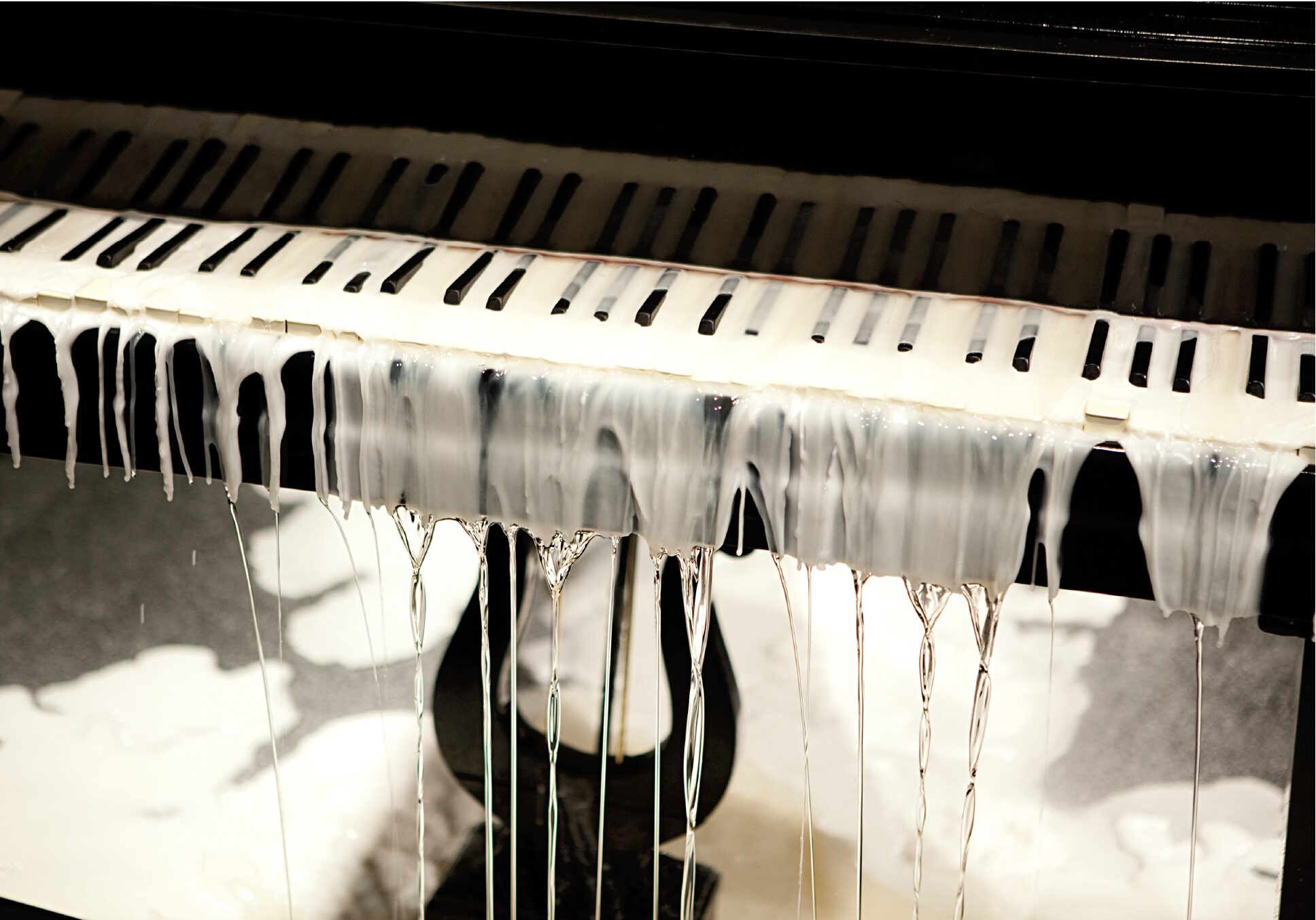
Metade da fala no chão_Piano surdo (“Half of the speech on the ground_Deaf Piano”), still of a performance at the 29th Bienal de São Paulo, 2010. Courtesy the artist and Everton Ballardin.
All was still but for the gush of wax that continued to trickle out of the piano’s keyboard onto the floor…
Tatiana Blass: Waxing Poetic
The Brazilian artist couches big questions in winsome ways

September 1, 2013
In a 1985 performance of Fluxus founder George Maciunas’s Piano Piece #1, the French artist Ben Vautier systematically nailed down all of the piano’s white keys as Philip Corner played. Tatiana Blass, in a live performance at the 2010 Bienal de São Paulo, went one better by dumping several buckets of molten wax and Vaseline into the guts of a grand piano. As the wax congealed, it smothered the piano’s strings, leaving the player pounding away at his Chopin in ever greater frustration on a sticky, then finally soundless instrument. Defeated, he rose, bowed, and exited the stage. All was still but for the gush of wax that continued to trickle out of the piano’s keyboard onto the floor. The effect was at once grisly and strangely beautiful.
A video version of the piece, Metade da fala no chão_Piano surdo (“Half of the speech on the ground_Deaf Piano”), netted Blass the pipa Prize for emerging Brazilian artists the following year. Other “deaf instruments” from the same series include a shiny tuba with extruded pipes bent back inside its bell and five drum sets marooned in a sea of wax, exhibited as part of the group show “Unsaid/Spoken” at the Cisneros Fontanals Art Foundation in Miami last December.
With a wide-ranging practice encompassing paintings, video, installation, sculpture, and theater, Blass excels at allegories of the breakdown of communication. Just 33, the São Paulo native has been exhibiting her work for nearly 15 years, since her first group show in 1998, while she was working on her BFA in painting at the Instituto de Artes da UNESP. Her installation pieces began later, around 2004, the year she finished her teaching certification at São Paulo’s Centro Universitário Belas Artes. And with works that name-check Samuel Beckett and Paul Celan, it comes as little surprise to learn that Blass’s early ambition was to be a writer. “I still write poetry,” she notes. “I really like to incorporate literature as part of my work—not as a narrative, but the words can be another layer.”
Lately, words themselves have become plastic. In Hard Water, a video piece she produced during a 2012 residency at Gasworks in London, two actresses (Ilana Gorban and Debora Minà) sit on separate chairs in a white room, strands from several dozen spools of thread that line the walls and floor attached to their ladylike clothing and hats. They eye each other warily, then start demanding, “What?” “What?” “Why what?” in an absurdist dialogue that leads them to doff their hats and circle each other, creating a knotty web from which they cannot escape. “We are in real trouble,” one concludes at the end, an unexpectedly grave declaration after a volley of catty needling. In Blass’s world, the human condition may be funny, but it’s never a joke.
According to Nora Burnett Abrams, associate curator at the Museum of Contemporary Art, Denver, where Blass is showing Hard Water and a new piece, Electrical Room, through September 29, “As with many artists, I think she begins by posing questions that her work tries to answer. But what is so effective is that she articulates these answers in such brilliant yet simple ways.” Abrams likens it to the work of Gabriel Orozco, Damián Ortega, or Ryan Gander, “who similarly take everyday objects and make them
strange, even surreal.”
For instance, the wax—which Blass was inspired to use after her first experiences casting at a foundry— appears in several of her works. “I was interested in putting some action into the sculptures,” she says. Early on, she attached wax versions of sleeping dogs to heating plates that slowly melt them away. For this novelty they might be seen as almost toylike; instead, the contrast of the smooth, molten pools against the carefully detailed whorls of fur around their joints is devastating. Fim de Partida (“Endgame”), 2011, shown at the cultural center of the Banco do Brasil in Rio de Janeiro, features wax renditions of the characters in the Beckett play, rigged up to light reflectors that ultimately destroy them. “I loved the idea that the sculptures are melting in a kind of continuous end,” she states. Subsequent works concealed a secret inside. Luz que cega_sentado (“Blinding Light_Seated”), 2011, is a cast-wax figure of a man seated backward in a chair with a spotlight trained on the back of his head like a laser. Over the course of two months, the wax melts down, revealing a cast-bronze spinal column.
Blass’s works often bear a tactile quality that speaks to our innate desire to approach, to reach out, but the artist has a keen eye for how our desperation to connect can literally gum up the works of our interactions. In her pieces, this manifests in bursts of chaos: Yarn explodes, wax puddles, televisions flicker. But here and there the visual noise blanks out, a static pop. There are the stencil-y paintings recalling 1970s-era wallpaper that snag on certain shapes, dragging them across the fabric surface. There is the sculpture of a horse, Paréo (“Race”), 2006, which cuts off abruptly above the knees of the startlingly lifelike white marble legs. There is Zona morta (“Dead Zone”), 2007, a living-room interior that splits at hip level, appliances and furniture bisected by a horizontal band of white space that confronts you at eye level. “I liked that…you could see the presence of the invisible,” she says.
That sense of suspension is taken upagain with a very different formal tack in her hushed, semiabstract acrylic paintings, such as the 2009–12 series “Teatro” and “Acidente,” the latter of which was shown at Lisbon’s Carpe Diem and at Galeria Millan, in São Paulo, and features overlapping planes of empty stages or runways, sometimes with airplanes or ocean liners or dogs. “The dog appears as an impossible actor, something a little absurd in this context,” Blass explains. “I try to build my own language, my own vocabulary.” At base, this language is an attempt to describe “the presence of death”; but, she cautions, “it’s not the idea of loss, it’s more of a metaphor.”
And while issues of silence and visibility have taken on a different tenor since the protests that rocked Brazil’s cities this past summer, Blass avoids any outwardly political content. “I don’t like the idea of a ‘message,’ ” she says. “I think art has to provoke. There are many possibilities for readings, but I don’t like to define them so specifically.”
For her first solo show in New York, opening next month at Johannes Vogt Gallery, Blass is preparing a multimedia exhibition based on the theme of an interview. “It’s about the idea of a public speech that positions you as a kind of actor,” she explains. It builds on her Electrical Room piece in Denver, which employs some 50 items of vintage audiovisual equipment—televisions, video cameras, microphones—some assigned to characters in a cacophonous cross talk. Increasingly, she adds, she is interested in working in a performance vein. “I saw Tino Sehgal’s Documenta piece and really liked it; the experience was very powerful,” she says. “And the work in Denver gave me a lot of ideas for other works. I like this mixture of theater and fine art and music.”
It’s clear that she’ll soon need a bigger stage to realize her inspirations. “The way that I have ideas is to do the work,” she says. “There is a common sentiment that too many shows is a bad thing, but for me, working that much is my nature.” An end is also a beginning, and it’s how she goes on.