The compositions feature congregations of like objects—a heap of metal signage letters, a thicket of brooms—arranged in a precarious balance and a pleasing counterpoise.
Alejandra Laviada: De-Construction Sites
Alejandra Laviada finds beauty in Mexico City's abandoned buildings

June 1, 2010
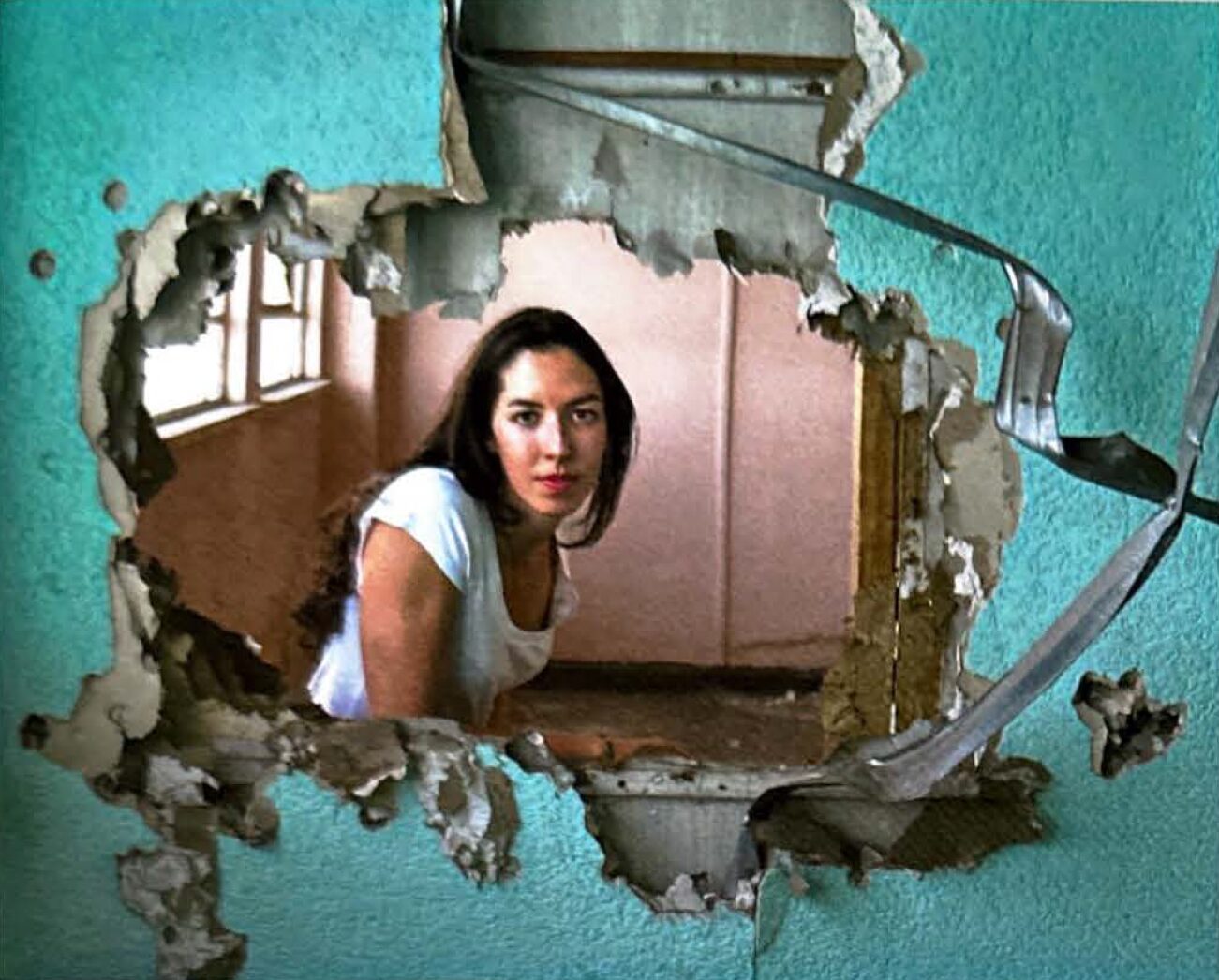
Alejandra Laviada is having a breakthrough. Literally. These days, when the 29-year-old photographer goes to her makeshift studio in one of the run-down abandoned office buildings that fill Mexico City’s historic center, she brings her camera, her tripod, and a large hammer. She takes a swing at a wall. And then she takes her shot.
The resulting images—a robin’s-egg blue partition smashed in to reveal another in pale pink, or a yellow surface spewing chipped drywall—are like wormholes from one room to the next. “I’m interested in cycles of destruction and construction in all the sites I photograph,” says Laviada. “And, in general, in the language of the city.” Her projects to date, staged within similarly dilapidated buildings in the Centro Historico, have focused on what she terms “endangered” environments in her hometown—by some estimates the third-largest metropolis in the world—caught in the slipstream of rapid change. For local artists, she says, “there’s a lot of raw energy and contrast and a lot of material to work with.” She has certainly found plenty. The holes, part of a series called “De-constructions,” like her previous works featuring artful arrangements of discarded objects she finds onsite, hover somewhere between sculpture and photography—even performance. Although Laviada has been following it lately with particular zeal, the impulse to intervene in a composition is rooted in her training as a painter. She graduated from the Rhode Island School of Design (RISD) with a BFA in painting in 2003, going on lo earn a master’s In photography al the School of Visual Arts in New York in 2007.
Impressed early on by the canvases of Rauschenberg and Basquiat and, later, of Rothko and Richter, she chose to concentrate on painting at RISD because it seemed the most ‘open” major. “Bock then I did a lot of collage,” she explains. “I used photography in the paintings, but not as a straight medium. I’m always trying to question or redefine what the boundaries are between the different disciplines—how one can define the other, and vice versa.”
This cross-disciplinary urge is one reason she shifted to photography in 2005. In the middle of her MFA studies, she returned to Mexico City, where she was born and raised, and discovered the abandoned Hotel Bamer, which in 2006-07 became the base for her series of that name. Each of the rooms presented a new state of dismantlement and decay. In one shot a white fabric lamp shade lies suggestively discarded on bright-blue shag carpeting; in another chalky prints from a dozen shoes form a kind of timelapse dance map on poured concrete. A sheaf of five mattresses has been filed in an alcove. The images appear objective but inspire a how-did-that-get-there curiosity.
Laviada is hardly the first artist to find beauty in ruins and poetry in the banal. On some level, her work calls to mind the ephemeral street sculptures of Gabriel Orozco (“I think his writings are phenomenal”) or Robert Polidori’s series on Cuba or on post-Katrina New Orleans. But she herself sees a distinct difference. “There were so many people documenting these kinds of places, and I felt that it was more about the nostalgia. And I didn’t really feel like that was what I wanted to say,” she explains, adding that merely photographing dilapidation seemed inadequate: “I missed the process of painting, where you’re really involved with the subject and it’s more like a physical act. So I started intervening in the spaces I was photographing, building sculptures and doing whatever I could in the space. It’s more natural, more real lo me than just pointing the camera and taking a picture.”
Finding a good site that contains objects from its former life takes time and legwork. “Access is always the most difficult part.” she says. ‘You can’t just walk in.” So she has been working with two organizations, the governmental Autoridad del Centro Historico and the private Fundación Centro Historico, that own or manage properties in the area and are invested in its revitalization. “It’s where the city was founded.” she says. “There are all these layers of history. You’ve got the Aztecs and then the Spaniards and the colonial architecture built on top of the pyramids. And there are these semimodern buildings from the 1950s and ’70s completely run-down. It’s almost like an archeological dig.”
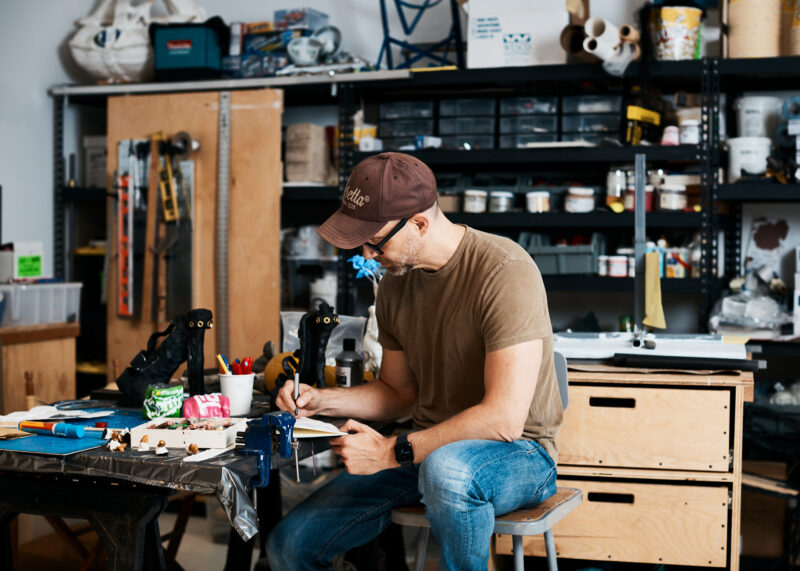
Laviada shoots with a Mamiya 6×7 medium format camera, using only natural daylight, and frequently brings a friend along for safety and heavy lifting. Once she has found a location, she will spend anywhere from one to six months there, visiting daily at first and then a few times a week, attuning herself to minute changes. “Sometimes I’d leave a window open and all the carpet would become a huge stain,” she recalls. “Every time I revisit a space, I see something I hadn’t seen the previous time.” She devotes days to gathering and categorizing the objects she finds, testing different combinations and backdrops for maximum effect, but often walks away from her assemblages when she is done.
The series “Juarez 56,” 2007, and “Photo Sculptures,” 2008, were far less concerned with the settings than with what she found in them. The compositions feature congregations of like objects—a heap of metal signage letters, a thicket of brooms—arranged in a precarious balance and a pleasing counterpoise. (Laviada admires the works of Eduardo Chillida and Richard Serra, although she has never taken a sculpture class.) She doesn’t bring in props or take her subjects out of the building. “I’ve always thought it’s interesting how we accumulate things throughout our lives, and some of them have a personal meaning, but in the end they’re all useless,” she says, adding that items betraying wear and tear or hinting at their former lives “speak differently to me. I’m interested in how they reveal part of the history or the function of the spaces I’m photographing, and in creating my own stories for them.” She points to her 2008 series “Typologies,” in which all manner of discarded chairs in odd-couple pairings seem to take on human qualities such as sagging flesh and broken limbs. “It was like I was photographing the people that sat on them,” Laviada remarks. “I like the idea of changing your perception of these objects or your experience of these objects, after you see the pictures.”
Fifty works from various series are on view June 9 through July 25 at Madrid’s PHotoEspaña festival, which in 2009 selected Laviada for its breakout Descubrimientos prize, granting her a solo show at this year’s event. That award brought her work increased prominence in Mexico, where it is less well-known than it is abroad (she is represented in New York by Danziger Projects, which mounted her first American solo show in October 2008). This spring she made her hometown museum debut at the new Museo Experimental El Eco in a three-artist exhibition curated by its director, Tobias Ostrander. The attention is flattering, but for the moment Laviada is busy scouting a new building site and experimenting with a recently purchased glass cutter. Another tool to leave a mark? “Exactly,” she says.