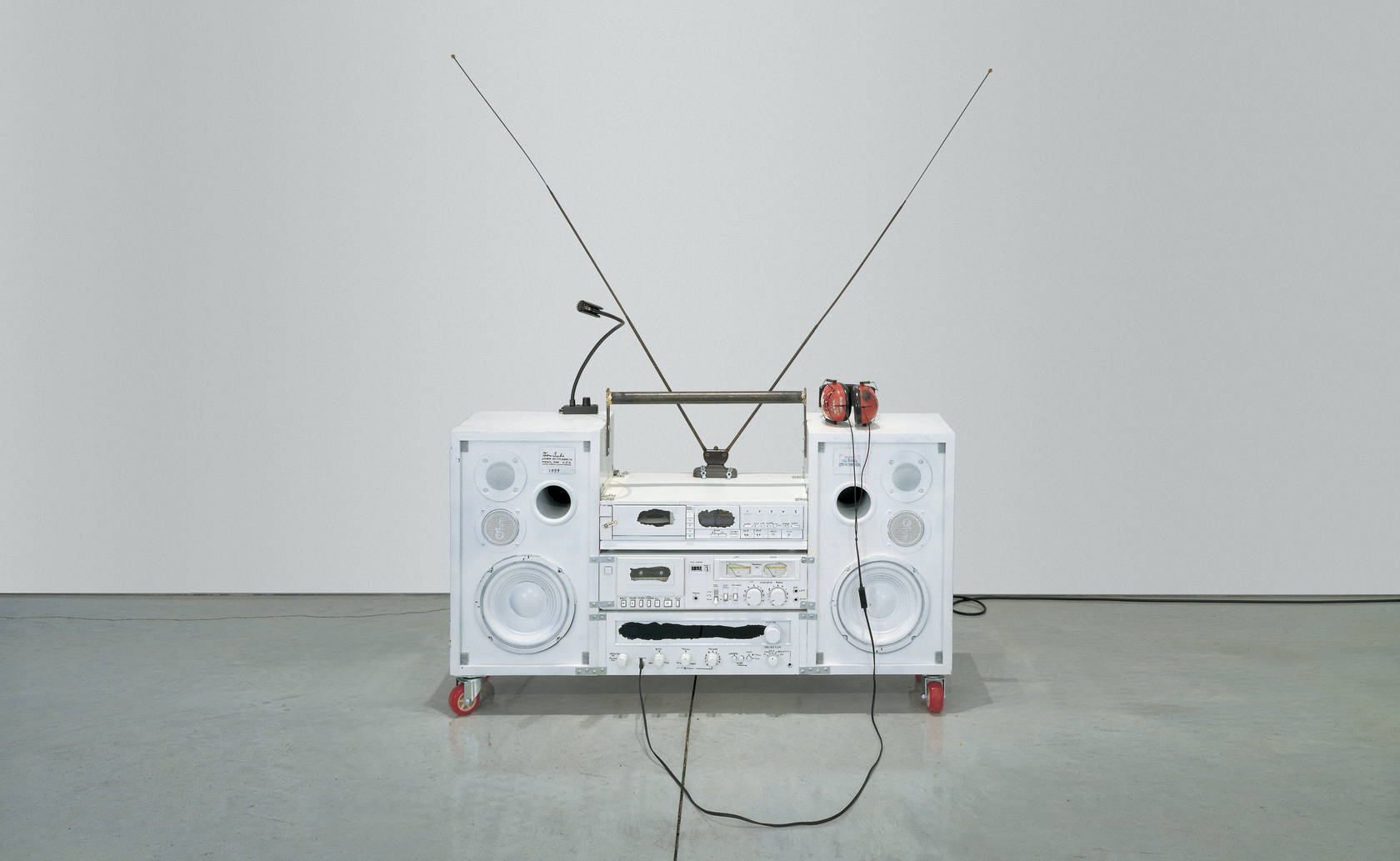
Tom Sachs, Model One, 1999. Mixed media. 32 x 41 x 14 inches. Collection of Shelley Fox Aarons and Philip Aarons, New York. Image courtesy Tom Sachs Studio.
…[T]he boomboxes strike as an uncommonly personal side project.


Tom Sachs is best known for his ersatz approximations of useful machines and
objects: bathroom fixtures fashioned from cardboard Prada boxes, faux Swiss
passports dispensed from behind a bulletproof bodega window. These clever
commodities reached a peak i n 2012 with his Creative Time-backed takeover
o f New York’s Park Avenue Armory for “Space Program: Mars,” in which the
artist mounted a participatory interplanetary installation featuring replicas of
all-terrain vehicles, a mission control room, a suit-up station, lab units for
scientific measurement, and more. But in one line of Sachs’ practice, going
back to 1999, the jerry-rigged machines actually work: his boomboxes, 22 of
which just went on view at the Brooklyn Museum.
A s Sachs recalls, “I have been making boomboxes since childhood. I hooked
my Sony Walkman up to a set of mini speakers and Velcroed them to a block of
scrap plywood. It was a clusterfuck of wires. In 8th-grade woodshop, I made a
box for the whole mess out of pine. It had a knob to hang the headphones that
was made out of a broomstick.” After stints at the London School of
Architecture and i n Frank Gehry’s studio, he continued in the same vein as a
young sculptor in New York, creating bricolage versions of things he wanted
to possess, like Mondrians outlined in gaffer’s tape on plywood. According to
the show’s curator, Eugenie Tsai, “One of the most distinctive aspects of
Sachs’s sculptural practice is his transformation of ordinary materials into
playful and scrappy one-of-a kind objects. What is amazingly consistent in
the works from 1999 to the present is the degree of invention and the evidence
of the [artist’s] hand in each object, no matter how large or small.”
Each boombox has a distinct personality. The earliest piece in the show, Model
One, from 1999, is the most humble in stark, hand-painted white, but they
quickly grew more fanciful, as demonstrated by the umbrella-topped Guru’s
Yardstyle from the same year. More recent iterations like Phonkey, 2011, and
Sarah, 2014, incorporate inventive appendages from his larger space series
and recent focus on Japan. Part creative recycling of obsolete technology, part
salute to their use as a protest tool, part fanboy homage to the music they
blasted (disco, early hip-hop) in their heyday, the boomboxes strike as an
uncommonly personal side project. Sachs told T Magazine during the
installation of the show’s previous iteration, at the Contemporary Austin,
“The nostalgia I feel for these boomboxes is intense. But it’s not exactly
nostalgia-because I haven’t let them go.”
For those who crave the surround Sachs experience, check out the artist’s
fully-fledged homage to the Japanese tea ceremony at the Noguchi Museum in
Queens, through July 24, and mark your calendars for June 16, when Sachs
and Questlove will host a discussion about art, science, and music.