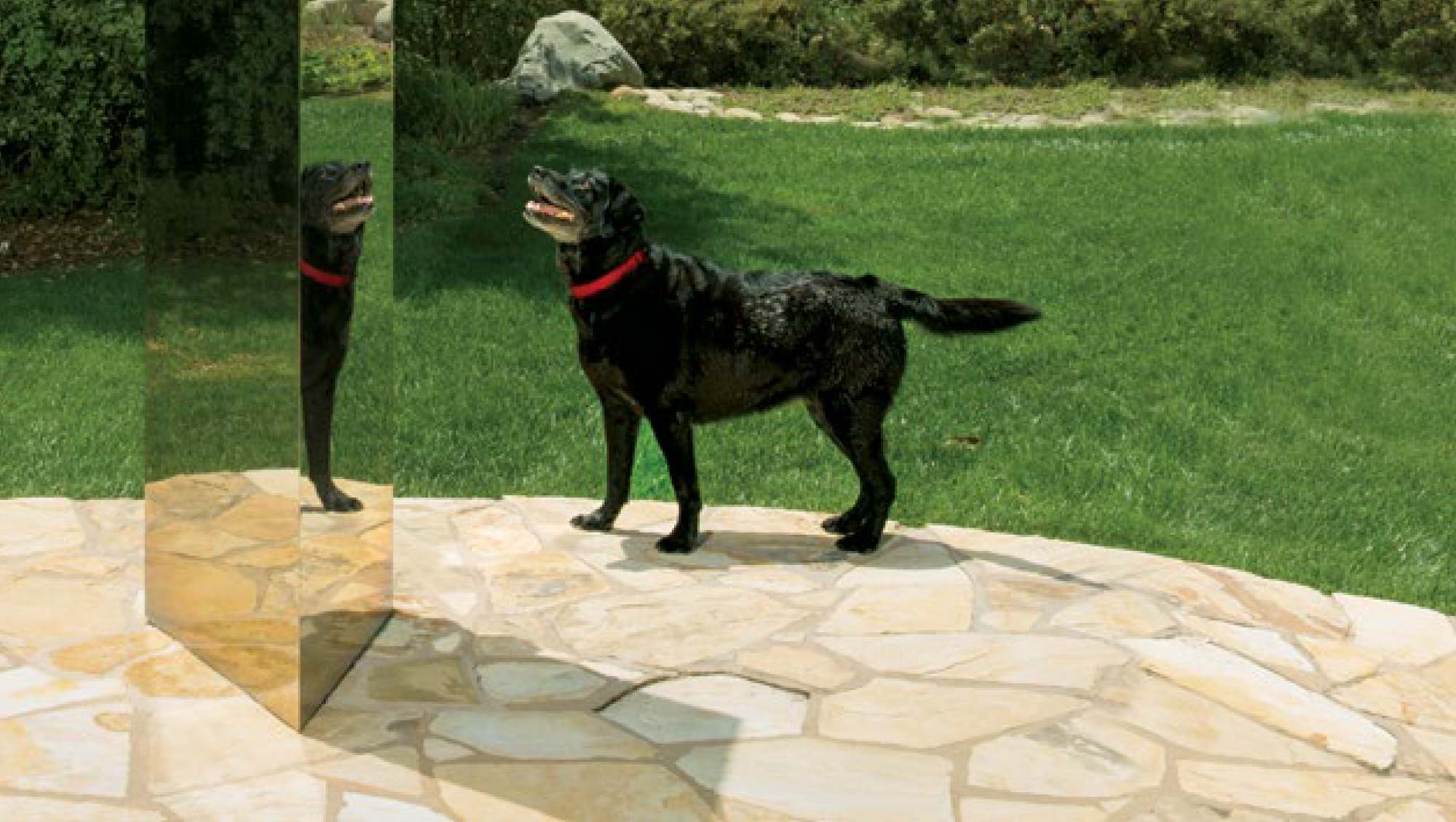
He lost some sleep over the expense until the piece was delivered, but once it was installed on the flagstone patio, overlooking the hills and the ocean, his doubts evaporated.


As Jarl Mohn was preparing to take the helm of National Public Radio this July, the transition team knew they would have to find a way to justify to loyal listeners his rather colorful work history as founder of the E! Entertainment Television network and general manager of MTV and VH1. Such an explanation was only necessary for those who weren’t already familiar with him from 15 years as chair of the Southern California ACLU, his seat on the board of councilors at USC’s Annenberg School for Communications and Journalism, as a turnaround artist in charge of Pasadena’s NPR affiliate KPCC—and, with his wife, Pamela, a major benefactor of the arts in the Los Angeles area. With a wide-ranging résumé that also includes stints as a DJ and a bodybuilder at Gold’s Gym, there is one area of his life where he is laser focused: his art collection. Or, more accurately, collections, plural: of Minimalism and Light and Space artworks from the 1960s and ’70s, and of emerging L.A. artists of the 21st century, which he loves sharing with museum groups, curators, and other visitors to his Brentwood and Manhattan homes.
“Jarl has the perfect collector trifecta: an authentic passion for art and artists, exquisite taste, and a keen and curious eye,” says Ann Philbin, director of UCLA’s Hammer Museum. “It’s hard to imagine a better steward for NPR—someone who is civic minded, generous, and deeply devoted to art and ideas.”
The Mohns, who married in 1983 and have two grown daughters, began buying art in the mid 1990s at Pamela’s suggestion. “A bit of this and a bit of that,” is how she describes the early acquisitions. The first pieces were three images from Larry Clark’s 1963–71 “Tulsa” series of black-and-white photographs: the crouched artist shoving a pistol into his mouth, the pregnant woman shooting up, and the infant in a casket. When it came to hanging them, however, Pamela put her foot down—not with their young daughters at home. So Jarl brought them to the ACLU office, “but they were apparently problematic there, too,” he recalls with a chuckle. Today the trio resides with the Mohns’ elder daughter. Although their collecting focus has shifted, they have never sold a piece.
The turning point came, Jarl explains, in 2001, when he walked into Hauser & Wirth in New York and spied John McCracken’s stainless steel triangular column Triton, 2000. “I saw it, stopped short, and said without even thinking, ‘I’ll take it,’” he recalls, a bit abashed even now at the audacity of the impulse buy. He lost some sleep over the expense until the piece was delivered, but once it was installed on the flagstone patio, overlooking the hills and the ocean, his doubts evaporated. “It was at that moment that I knew exactly what I wanted to do,” he says. He and Pamela undertook a project to assemble an informed and comprehensive collection of historical Minimalism, with special attention paid to Southern California artists associated with Light and Space, including McCracken as well as Larry Bell, Mary Corse, Robert Irwin, John McLaughlin, James Turrell, DeWain Valentine, and Doug Wheeler.
Many of these names mingle in the deep, Gus Duffy– designed entry hall, where a series of cubes exuberantly flaunt varied approaches to the form. There is a 1970 tension box in amber Plexiglas by Donald Judd, a pristine glass vitrine on a transparent pedestal by the finish-fetish-oriented Bell, a mirrored-glass Walead Beshty box set on its cardboard FedEx shipping container, and a recent edition of Hans Haacke’s acrylic Condensation Cube, 1963–65, with an ever morphing array of moisture droplets coating its interior. Almost all carry some kind of backstory, which Jarl relates with a radio announcer’s relish. Of the Beshty, acquired from Regen Projects, he says: “When it arrived in the FedEx box, my wife called me in a panic and said, ‘You won’t believe this; we have a real problem.’ I said, ‘No, Pam, it’s supposed to be broken; that’s the whole point.’ She said, ‘That’s the problem—it’s not!’ I thought we’d have to throw it off the counter or something.” Further inspection revealed the box was, in fact, cracked in two places on the bottom.
The cube theme continues into the living room, where a large, white Wheeler encasement glows eerily on the wall. The Mohns chased it over a period of seven years, turning down an offer from one gallery at what Jarl deemed too high a price before finally snapping one up for $290,500 at Christie’s in 2009. “Most of the things in the collection, once it got started, we knew exactly what we were looking for, and it just took time to find the right one in good condition,” he says. “Usually we have an Irwin disk opposite this piece, which is nice because you have the circle and the square, reflected light and internal light, but it’s currently on loan.”
Back in the entry, a stroll in the opposite direction leads to a hallway with an unusual Carl Andre floor piece in six different metals and one of Tara Donovan’s quotidian material sculptures—a cube consisting of 750 pounds of straight pins, which the Mohns acquired from Ace Gallery in Los Angeles. Jarl credits dealer Douglas Chrismas with introducing him to Minimalism in the mid ’90s, but admits it didn’t take hold until later. Jarl, a math major at Temple University, was ultimately seduced by the radical simplicity proposed by artists like Judd and Dan Flavin, as well as their Euclidean aesthetic. “Like Flavin said, what you see is what you see. That’s part of what I like about it,” he says. “And in a life that is very chaotic, I love the order.” Today he and Pamela work with Jonathan Binstock of Citi Private Bank Art Advisory on targeted purchases.
One notable feature of the Mohns’ Minimalism collection is that it does not ignore women artists, who were marginalized even by their male colleagues. The main staircase features two large, pearlized white canvases by Corse, while a spring green pedestal by Anne Truitt faces off with a trio of Andre’s found-wood steles on the landing.They also own works by Jo Baer, Agnes Martin, and Helen Pashgian. Upstairs, a Sol LeWitt wall drawing pairs with one by Channa Horwitz that appeared in the “Encyclopedic Palace” exhibition at the 2013 Venice Biennale. “She was working directly in response to what LeWitt was doing,” notes Jarl. “I really like it when you know the artists were friends with each other,” says Pamela. “It adds a layer.”
The collection’s real showstopper, however, is Picture Plane, 2002–04, a custom-built Turrell sky space–slash–screening room, the only one of its kind. The Mohns entertain regularly, and after watching the sun set through the retractable roof, they fire up the projector (film or digital, as required) while guests recline in Turrell’s aeronautically inspired leather seats. “We live in it,” says Pamela. “Even the dogs know, ‘Do you want to watch a movie?’ And they go run upstairs.” Although they are now good friends, the project came about before the couple had even met Turrell.
Jennifer Kellen, who worked with the artist at Ace, proposed it when she was at the house installing another piece. “I wrote a check just to see the plans,” says Jarl, chuckling, “and then he disappeared for six months and I was sure I’d been had.” It ultimately took two years to complete, requiring a total reconstruction of the roof section, but in that time period, notes Pamela, Turrell discovered colored LEDs. Jarl chimes in, “The delays actually made it a better work.”
The Mohns are known around town for giving as much as they get. Aside from donating funds to the recent Turrell show at the Los Angeles County Museum of Art, the couple helped underwrite Michael Heizer’s Levitated Mass, 2012, on the museum’s campus. The 340-ton granite boulder suspended over a narrow channel was conceived by the artist in 1969, but Heizer, whose propensity for long-gestating works is legendary, did not locate the ideal rock until 2006. Jarl says, “I got a call from [lacma director] Michael Govan. He said that Heizer had found his rock, but it was at a quarry in Riverside and if he didn’t buy it by the end of the month, it would be turned into gravel.” Mohn ponied up $75,000 for the boulder—and then more than $100,000 just to weigh it for the move (an engineering feat unto itself that was documented by filmmaker Doug Pray). Says Govan, “I didn’t even hesitate. I knew that the one person who wouldn’t say ‘You’re crazy’ was Jarl. He’s a risk taker. It’s not that he goes for anything, but when he sees an opportunity, he’ll leap.” Their total contribution eventually ballooned to $1 million, an amount Govan says “grew with their faith.”
Jarl has also served on the board of the city’s Museum of Contemporary Art and was one of the first individual supporters to sign on to the Getty-sponsored “Pacific Standard Time” series of exhibitions highlighting postwar California art in 2011–12. The collectors’ current cause is the Hammer’s “Made in L.A.” biennial, for which they fund a $100,000 prize that went to the Botswana-born muralist Meleko Mokgosi by popular vote in 2012. For this year’s edition, the process has been revamped slightly to counter criticism over the voting theatrics, with the main award ceded to jury control and the addition of two $25,000 awards, one of which will be decided by the public. On view through September 7, the exhibition is attracting buzz for such artists as Samara Golden and Gabriel Kuri. The previous edition featured such rising stars as Kathryn Andrews, Liz Glynn, Ry Rocklen, Analia Saban, Brian Sharp, and Brenna Youngblood, all of whom the Mohns have been collecting in some depth for the past few years. Explains Jarl, “After I knew the pieces I was missing, the discovery factor went out of Minimalism. I wanted to start collecting something else for the sense of learning and challenging myself to break out of this aesthetic, which I love, but there’s so much more going on.” He pauses. “Especially in L.A. I think it is the most exciting place on the planet for all of creativity—film, television, music—and now it’s the epicenter for the creation of art.”
Perhaps because the innovations of earlier generations of California artists were undervalued, investing in emerging names at a point where it will make a difference in their careers is paramount to the Mohns. “It has required a degree of discipline, because there are artists who have been working here for years,” says Jarl. “I went back and forth on it, and ultimately decided that no, I’m only going to support young artists, and if they end up on a great trajectory, all the better.” One sculptor whom he feels represents the formal and thematic flavor of new L.A. art is Andrews, known for her slick yet perverse representations of everyday objects. “She’s tough, very tough. Did I tell you the story about what my younger daughter said about Tot Finder?” he asks about the artist’s evil clown decals adhered to glass framed to appear as a window shaded by blinds. “She said, ‘Dad, that brings up a lot of really uncomfortable feelings.’ I ran into Kathryn at Paris Photo L.A. and told her this, and she was just beaming.”
The couple attend fairs but rarely buy at them. They made their most recent purchase from Rocklen’s show at Untitled gallery in New York just before Frieze: Bar Mitzvah, 2014, an actual men’s room door from the Mandrake, a Culver City bar that is the de facto watering hole for the neighboring galleries, on which the artist re-etched the graffiti and filled in the channels with gold, silver, and copper. Think of it as a piece of the Cedar Tavern for today’s art hotbed—Mohn does, and hopes that in decades hence, his holdings of young SoCal artists will have the same resonance, “if we do our job well.”
It’s hard to believe anyone who has a Turrell sky space at their exclusive disposal would want for anything in the art department. But asked to indulge in a bit of fantasy shopping, an Eva Hesse, “one of the threaded boxes, though I hear they’re rare and fragile,” is Pamela’s choice. “There are a lot of things that would be great to have, exclamation points to the collection, if you will,” Jarl acknowledges. “But to me, an early 1960s Judd stack is the real missing link.” He sighs. “Like every collector, there are two or three pieces I regret having passed on. I am happy to say I’ve never bought one that I looked back on and thought, why did I do that?” Which bodes well for the next generation of artists on which Mohn has set his sights.