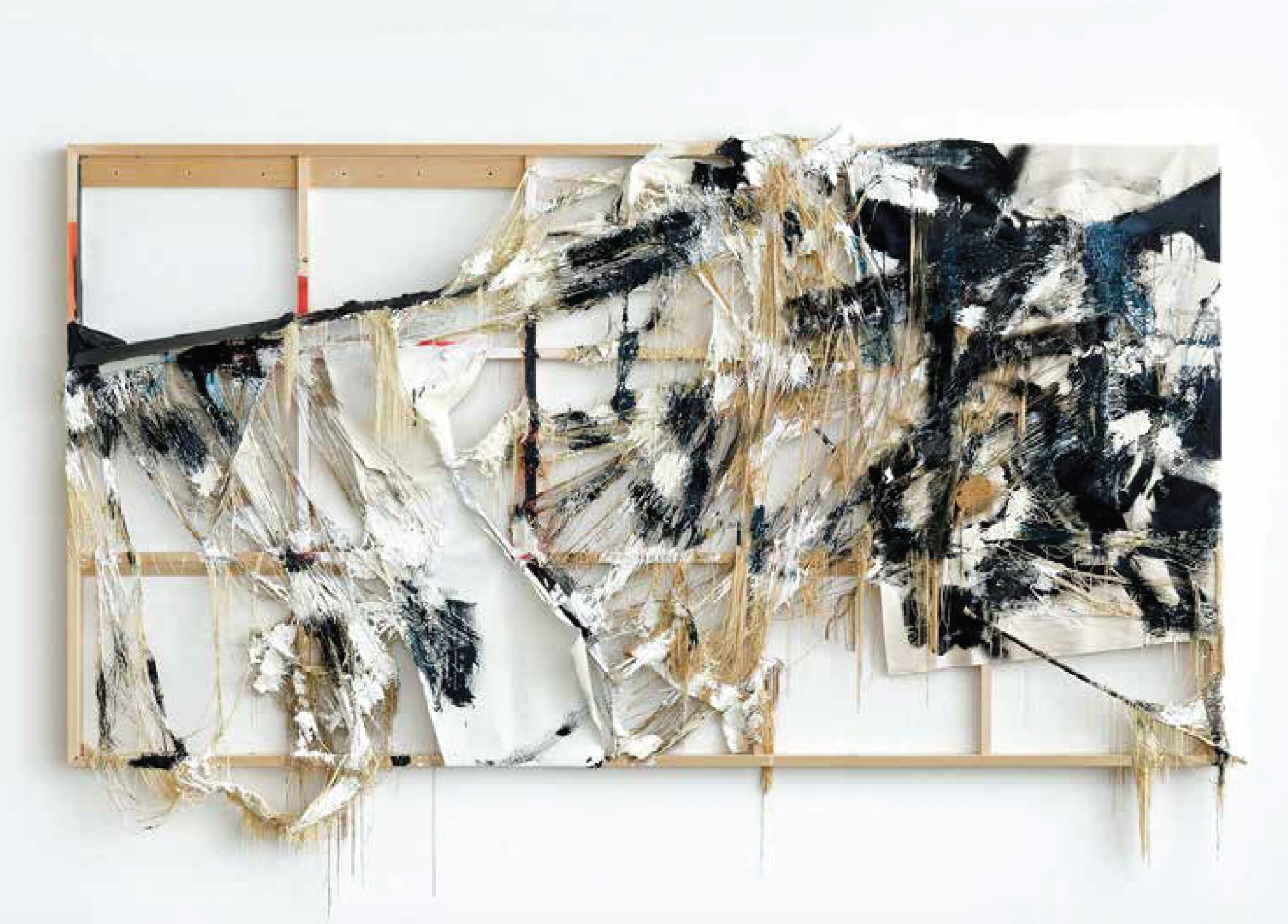
Music for a Drowned World, 2015. Acrylic enamel, oil, cork, string, canvas, and aluminum, 70 x 130 x 8 in. Courtesy Rosy Keyser and Maccarone.
…[T]he artist has been rooting in the mulch of her own ideas about beauty and decay: the found and the created, the harnessed and the untamable…
Rosy Keyser
Maccarone, New York, April 25–June 6, 2015

September 1, 2015
With her large panels of collaged, corrugated aluminum and wood, Keyser stood on the more physical and experimental end of the 15 artists selected to represent a new breed of abstraction in the Walker Art Center’s 2013 “Painter Painter” exhibition. Since then, judging from the confident, if slightly uneven, group of works in her first show with Maccarone, the artist has been rooting in the mulch of her own ideas about beauty and decay: the found and the created, the harnessed and the untamable (the show’s title, “The Hell Bitch,” is a reference to Woodrow Call’s horse in Larry McMurtry’s 1985 Western novel Lonesome Dove). These pieces find their studio origin in a kind of “mother” work, a canvas that has become a compost heap for various experiments: the Hell Bitch herself. While not included in the show, her imprint is everywhere on these unruly offspring.
Building on previous solo outings, wherein Keyser deployed rural cast-offs as grace notes to her somber-hued abstractions—a basket here, sections of egg carton there—in these works the artist attacks her increasingly varied materials with impartiality and zeal. Along with scraps of nylon webbing, cork, horsehair, chopsticks, fringe, and bags of buckwheat hulls that enter the frame, she has added mica and different types of paint. This mixed-media buildup on the surfaces makes them simultaneously more and less like paintings. A case in point is Mi Tata (Drug Mule), 2015, which fuses sections of a beaded car seat to the surface in echo of the swoops of paint below. Elsewhere, in Animal Fruit, 2014, and Witches’ Sabbath, 2015, swags of fringe get caught in the paint or drizzle out of bounds.
There are deliberate blanks, too, sections of canvas peeled back from their supports to reveal the gallery wall underneath. But deconstruction is not Keyser’s game; the works are fervidly built, the product of forces coming together, not coming apart. In one of the largest and most impressive pieces in the show, Music for a Drowned World, 2015, the canvas hangs off the stretchers like wounded flesh on bone, an effect amplified by the dangling skeins of string that skip from left to right, guiding the eye across the painting. Reestablishing Keyser’s keen sense of rhythm, in scope and emotional register, it’s more akin to opera than to the jazz riffs typified by previous paintings.
The utilization of blank wall space is taken to an intriguing extreme in a pair of works of a very different stripe. Between the Hips and Between the Knees, both 2015, are composed of powder-coated steel tubing applied directly to the wall to describe a frame with spare, runic forms within. From the bottom dangle one or two paint-slashed sandbags, an obvious call-out to Robert Rauschenberg’s famous 1959 combine Canyon, but allied with a delicate minimalism rather than a kitchen-sink maximalism. They might be read as the rinsed slate, the calm after the storm—and insofar as they signal the start of another rigorous investigation of painting’s possibilities, they show that Keyser, despite the newfound richness of her textures, is more than a skilled material fetishist.